
Beyond Haber-Bosch: The 80-Bar Catalyst Revolution That is Transforming Ammonia Production Economics
- Posted by Teec Courses
- Categories Blog, Business
- Date January 8, 2026
- Comments 0 comment
Beyond Haber-Bosch: The 80-Bar Catalyst Revolution That is Transforming Ammonia Production Economics
In the chemical industry, breakthroughs rarely arrive as dramatic “eureka” moments. More often, they emerge when a seasoned engineer finds a lever inside a system everyone assumes is already optimized—then pulls it hard enough to change the design rules for an entire generation of plants.
That is the story many colleagues associate with Dr. Ray Le Blanc—a long-time engineering and technology leader at M.W. Kellogg / KBR, widely linked to technology advances in ammonia production and synthesis-loop modernization. (Springer Nature Link)
At the center of this story is a deceptively simple metric: synthesis reactor pressure.
For decades, ammonia synthesis loops were commonly designed around “high pressure = higher production rate” logic. Pressure improves equilibrium conversion and reactor volumetric productivity, but it also drives capital cost, mechanical risk, and energy consumption. Lowering loop pressure is therefore one of the most valuable “system-level” wins you can deliver—if you can overcome the chemistry and engineering penalties that normally come with it.
Ray Le Blanc’s catalytic and process work is often described in that exact framing: move a synthesis loop from ~120 bar down toward ~80 bar class operation, while maintaining performance and reliability—transforming the economics, operability, and safety case for major ammonia facilities.
Why is pressure expensive (and why it mattered)
Dropping loop pressure from ~120 bar to ~80 bar doesn’t sound like much until you translate it into plant reality:
1) Major CAPEX relief—across the entire loop
Lower pressure enables thinner-wall high-pressure equipment, reduces requirements on forged components, changes nozzle loads and thickness rules, and can materially simplify the compressor train. In modern ammonia technology discussions, KBR’s low-pressure loop is frequently associated with ~9 MPa (~90 bar) operation. (Wiley Online Library)
Even when the exact “before/after” number differs by plant, the direction is consistent: pressure reduction cascades into smaller and lighter equipment, and that can mean substantial construction cost savings.
2) A safer mechanical envelope
High-pressure synthesis systems store enormous energy. Lowering pressure reduces:
- Stored energy in the loop
- Consequences of loss-of-containment events
- Severity of mechanical failure modes (especially in high-pressure shells and piping)
Safety improvements aren’t a marketing line here—they are a direct consequence of basic thermodynamics and mechanical design.
3) Less compression power (and less CO₂ indirectly)
Ammonia plants spend a meaningful portion of their operating power budget on gas compression. Lower pressure targets generally reduce compression duty, which reduces energy use and (depending on the site power and fuel mix) lowers the plant’s indirect emissions intensity.
KBR’s public statements around revamps and proprietary equipment upgrades frequently emphasize higher overall energy efficiency and reduced greenhouse gas emissions per ton of product when modern technology packages are adopted. (KBR)
So yes—pressure is a number on a datasheet. But it also becomes steel, horsepower, risk, and money.
The real trick: you can’t just “turn the pressure down.”
Here’s the hard part: ammonia synthesis is equilibrium-limited and strongly affected by pressure. Push pressure down and you normally pay a penalty in per-pass conversion and reactor productivity. So if you want an 80–90 bar synthesis loop to behave like an older 120 bar loop, you need a new lever.
That lever is catalyst activity—and this is where Ray Le Blanc’s name appears repeatedly in the ammonia technology lineage.
A catalyst capable of “buying back” the loss of pressure
Industry literature around KBR’s advanced ammonia synthesis (commonly associated with the KAAP family) highlights the use of ruthenium-based catalysts that allow operation at materially lower loop pressure than conventional iron systems, while sustaining high conversion performance. (Wiley Online Library)
The basic idea is straightforward, but delivering it commercially is not:
- Higher intrinsic activity can offset reduced equilibrium driving force
- Lower pressure reduces compressor duty, which improves energy economics
- But noble-metal catalysts introduce new constraints: poison sensitivity, support stability, thermal management, and long-term performance assurance
Turning that into an industrial reality is not “chemistry only”—it’s chemistry married to rigorous scale-up engineering.
The technical challenges he had to overcome (and what makes this engineering, not just R&D)
When you attempt a pressure step-change in a synthesis loop, you are fighting on multiple fronts at once.
1) Kinetics vs. equilibrium—under real plant constraints
Lower pressure reduces equilibrium conversion, so your reactor system must compensate through:
- Higher catalyst effectiveness and utilization
- Optimized bed design/staging
- More aggressive heat management to keep the catalyst in its best operating window
It’s not enough to have a lab-active catalyst. You need a catalyst system that performs in the presence of:
- Trace contaminants
- Realistic temperature gradients
- Catalyst aging mechanisms
- Plant turndown and transient conditions
2) Catalyst durability and resistance to poisons
Advanced ammonia catalysts (particularly Ru-based systems) can be more sensitive to poisoning than traditional iron catalysts. The industrial challenge becomes: how do you protect a high-activity catalyst for years in a loop that inevitably sees upsets, trace impurities, and startup/shutdown cycles?
That drives deep engineering work on:
- Feed gas purification and polishing
- Materials selection and corrosion control
- Operating discipline and startup protocols
- Converter internals are designed to avoid local hot spots or bypass them
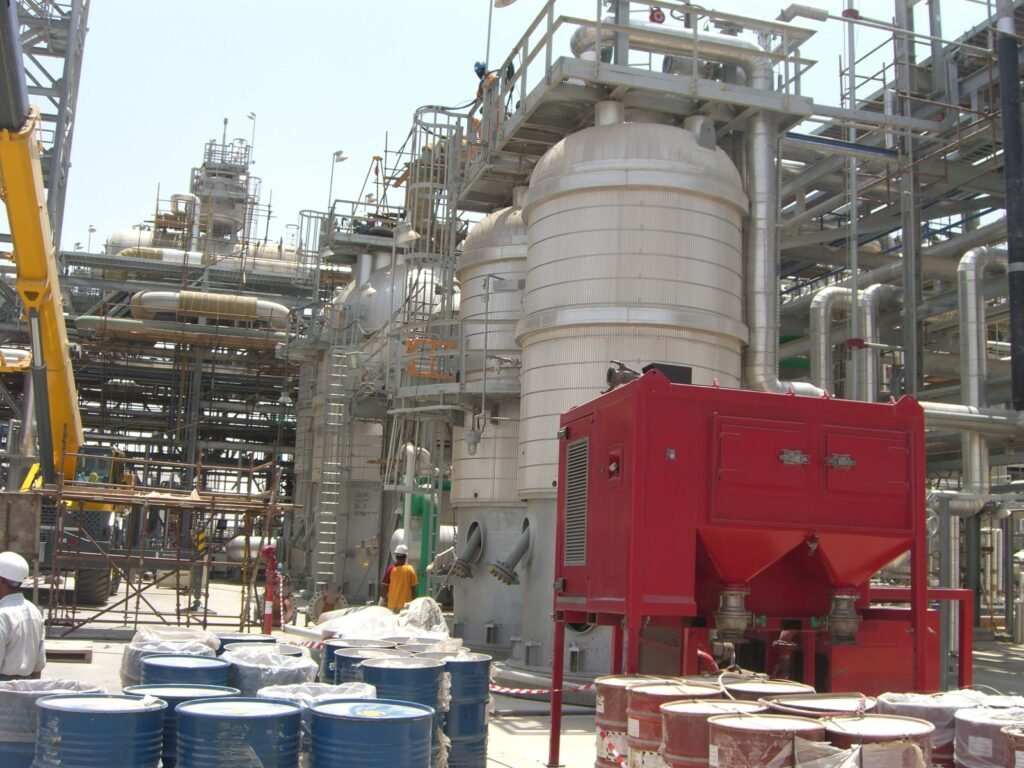
3) Reactor and internals design at scale
If you increase activity and push to lower pressure, you also change:
- Reaction rate profiles
- Heat release distribution
- Pressure drop management
- Mechanical loads and fatigue behavior
This is where a director-level engineering and technology leader creates impact: not by improving one component, but by aligning catalyst + converter design + loop compression + controls into a stable commercial package.
4) Making “innovation” bankable
Even a superior catalyst is useless if clients can’t justify it. Commercial adoption requires:
- Demonstrate reliability
- Predictable performance
- Clear maintainability and inspection strategy
- Convincing lifecycle economics
- Ray Le Blanc’s work is often referenced in the context of “technology that plants can bet their uptime on”—the standard that separates industrial chemical engineering from promising prototypes.
“Make ammonia with less energy”: a philosophy that aged well
Long before “net-zero” became the headline, ammonia technology leaders were already pursuing energy intensity reduction as an economic imperative. Ray Le Blanc is cited in historical technical references connected to that theme—make ammonia with less energy—which reads today like a preview of the industry’s current direction. (Springer Nature Link)
And that is what makes the 80–90 bar pressure story more than a process anecdote:
- Lower pressure supports lower energy consumption
- Lower energy supports lower emissions per ton
- Lower pressure can also make it easier to integrate new clean-ammonia configurations (especially when paired with green hydrogen, carbon capture, or electrified utilities)
In other words: a catalyst-enabled pressure reduction is not only a CAPEX/OPEX win—it is a platform for the future.
From KBR to Carbonholding: the same mission, updated for a new era
Ray Le Blanc’s career is also remembered for its continuity: a persistent focus on practical chemical engineering solutions—innovation that can be built, operated, and trusted on a scale.
After decades associated with ammonia and methane process development at M.W. Kellogg / KBR, he later operated in a consulting capacity (often referred to as JRL Consulting) following retirement from Kellogg/KBR. (Legacy)
Today, his reported advisory role with Carbonholding (Carbon Holdings) can be viewed as a natural continuation of that same life’s work—bringing proven process thinking to organizations shaping the next generation of petrochemical and industrial projects. Carbon Holdings positions itself as an Egypt-based petrochemicals developer established to support national industrial development needs. (Carbon Holdings)
The industry’s themes have evolved—efficiency, emissions, sustainability, resilience—but the engineering mission is familiar:
- Reduce energy waste
- Increase safety margins
- Improve capital efficiency
- Deliver reliable performance at scale
That is what makes Ray Le Blanc’s story enduring. The headline might be “120 bar to 80 bar.” The deeper lesson is how a catalyst breakthrough—when paired with system engineering—can reset the rules of what is economically and operationally possible.
Reference:
[1] K. Blok, “Fixing Atmospheric Nitrogen with Less Energy,” in Potential for Industrial Energy-Efficiency Improvement in the Long Term, Eco-Efficiency in Industry and Science, vol. 5. Dordrecht: Springer, 2000, pp. 167–224, doi: 10.1007/978-94-017-2728-0_6. Springer Link
[2] J. Humphreys, R. Lan, and S. Tao, “Development and Recent Progress on Ammonia Synthesis Catalysts for Haber–Bosch Process,” Advanced Energy and Sustainability Research, vol. 2, no. 1, Art. no. 2000043, Jan. 2021, doi: 10.1002/aesr.202000043. proceedings.com+1
[3] KBR, “KBR Awarded Two Ammonia Plant Revamp Contracts by Acron Group, Russia,” Press Release, Mar. 24, 2021. kbr.com
[4] “Joseph Blanc Obituary (2014) – Katy, TX – Houston Chronicle,” Legacy.com, published Jun. 22, 2014 (re: passing Jun. 19, 2014). legacy.com
[5] Carbon Holdings, “Carbon Holdings” (official website). Accessed: Jan. 7, 2026. carbonholdings.com

You may also like
Everything engineers need to know about API 510 and API 570 inspector certifications — what they test, who needs them, how to qualify, and why they’re required at Saudi Aramco, ADNOC, and major GCC operators.
Master piping design and P&ID reading with this complete guide for process engineers. Learn symbols, line classifications, instrument tags, and how to read P&IDs used in oil & gas, petrochemical, and industrial plants.
Saudi Aramco is the world’s most profitable company — and one of the most selective employers on earth. Here’s exactly how engineers get hired: the application process, assessment stages, salary bands, and what Aramco actually looks for.